
Introduction
Scope: This is our cross-platform conceptual guide on keys versus shared accounts. For platform-specific 2026 security audits with purchase tests and safety scores, see: Steam · Xbox · PlayStation · Nintendo.
Budget game listings rarely advertise what you are actually purchasing. A headline promising a AAA title at 80% off might deliver a legitimate activation code—or temporary login credentials to a stranger’s profile. The distinction between a game key vs shared account purchase is not academic. It determines whether you hold Digital License Ownership or merely borrow access that can vanish overnight.
Gray-market sellers blur these categories deliberately. Listings labeled “offline account,” “family share,” or “shared Steam library” often violate platform terms while exposing buyers to Account Recovery Risk, publisher enforcement, and financial fraud tied to Stolen Credit Card Fraud. This article explains what each offer type really means, why the cheapest path frequently costs the most, and how to protect the library you have spent years building.
LicenseAudit is an independent research resource. We do not sell keys or accounts and are not affiliated with Valve, Sony, Microsoft, or Nintendo. For broader marketplace hygiene, see our Game Keys Audit and Safety Guide. Platform audits: Steam · Xbox · PlayStation · Nintendo.
What You Are Really Buying
Before comparing prices, clarify the product category. Secondary markets sell three fundamentally different goods, and conflating them is how buyers lose money and access.
Legitimate Game Keys (Digital License)
A game key is an alphanumeric code—or a direct platform gift—that redeems a title to your account. After activation, the entitlement is associated with your profile under Valve’s Subscriber Agreement. You control the account, set recovery options, and retain access as long as the license remains valid and compliant with platform rules.
- Ownership model: License tied to your identity, not a shared credential pool.
- Transfer path: Some keys are giftable; others bind on redemption. Either way, the license lives on your account.
- Risk profile: Depends on key provenance—regional arbitrage, bundle extraction, or fraud—not on account dependency.
Key vs. Shared Access
Shared-access offers deliver login details to an existing account that already owns the game. You play while logged in as someone else, or use Steam Family Sharing under rules the seller controls. You do not receive a redeemable key and you do not establish independent Digital License Ownership.
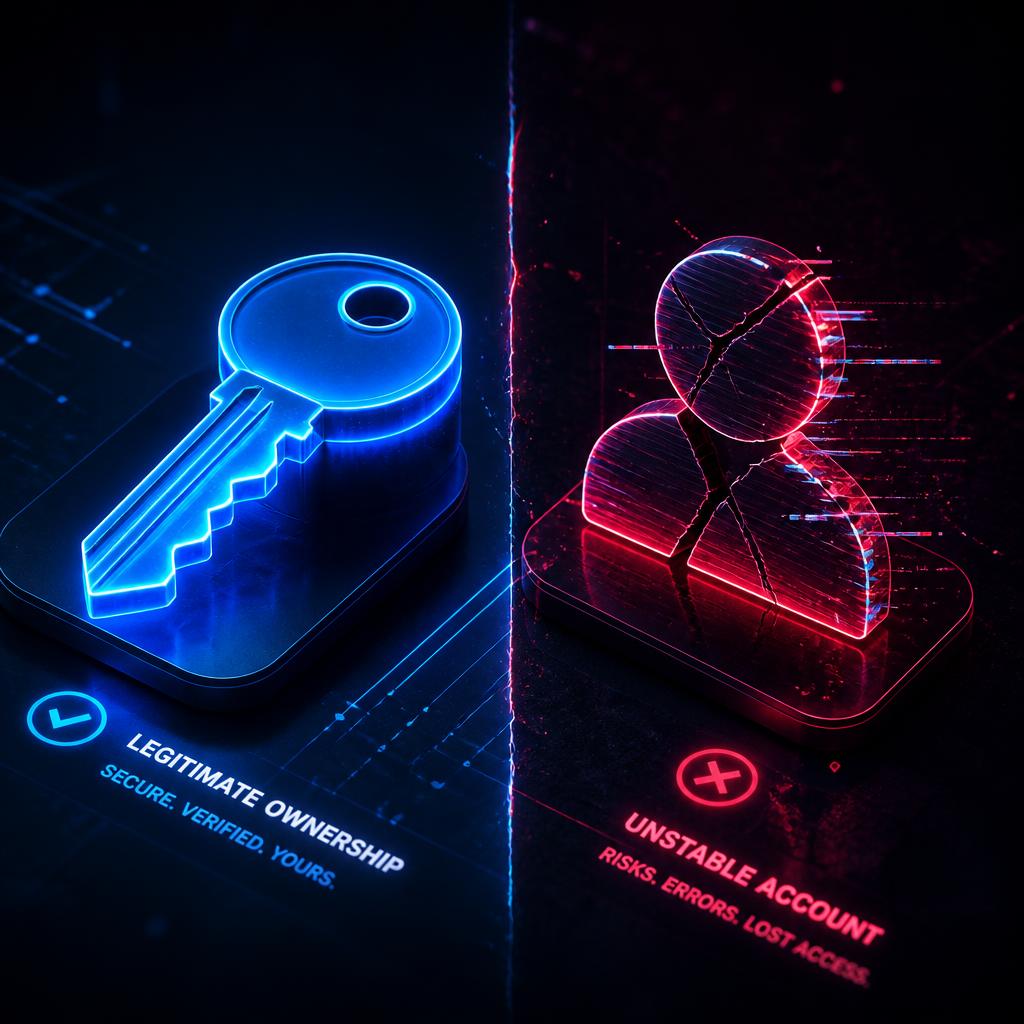
Sellers market shared access with phrases like “offline mode,” “never online,” or “100% working account.” These are positioning tactics, not guarantees. Valve’s systems can detect anomalous login patterns, concurrent sessions, and policy breaches. When enforcement triggers, you lose the game—and any payment is typically non-refundable because the listing disclosed account sharing, which platforms prohibit.
Account Rentals and “Lifetime” Shares
A third variant rents an account for a fixed period or sells “lifetime” access to a pooled library. Neither grants a license. The original owner retains recovery email, payment methods, and the ability to change passwords. Your entire purchase hinges on their continued cooperation—or their account not being banned first.
Core principle: If the seller sends a username and password instead of a redeemable code, you are not buying a game. You are buying temporary trust in a stranger’s account security habits.
The Risks of Shared Accounts
Shared Steam library schemes concentrate risk in ways individual key purchases do not. Buyers often discover the downside only after a password change, a ban wave, or a chargeback removes access.
ToS Violation and Enforcement
Steam’s Subscriber Agreement prohibits sharing account credentials and circumventing access controls. Selling login access is a clear ToS Violation. Valve may restrict the account, remove shared titles, or issue broader sanctions when abuse patterns are detected. Because you are not the account owner, you have limited standing in any appeal process.
Account Recovery Risk
The seller—or a previous buyer—can initiate password resets using the original email or payment verification. Account Recovery Risk is structural: whoever controls recovery controls the library. Even “honest” sellers may resell the same credentials to multiple buyers, creating a race for access.
Revoked Game License and Chargebacks
Games on a shared account may have been purchased with Stolen Credit Card Fraud or disputed charges. When the cardholder files a chargeback, publishers and platforms reverse the transaction. The result is a Revoked Game License on the host account—and your access disappears with it. Legitimate key resellers can face the same revocation risk if keys are fraud-sourced, but shared accounts amplify exposure because one bad transaction can wipe an entire catalog you relied upon.
Security and Privacy Exposure
Logging into a third-party account may expose your IP address, machine identifiers, and play patterns to the account owner. Some listings request that you disable Steam Guard or use a VPN—both of which weaken your own security posture and can trigger additional platform scrutiny on accounts you legitimately own.
- No independent proof of purchase tied to your identity
- No escrow dispute leverage when access simply stops working
- Potential linkage between your hardware and a flagged fraudulent account
- Loss of achievements, saves, and mods tied to a profile you do not control
Why Cheap Costs More
Shared accounts price below legitimate keys because the seller incurs no new license cost—they resell access they already control, often repeatedly. The discount is not a market efficiency; it is risk exported to you.
The Hidden Price of “Too Good to Be True”
A $5 listing for a $70 release should trigger investigation, not celebration. Sustainable discounts on keys typically reflect regional economics, bundle surplus, or promotional stock—not an 90% permanent markdown on fresh AAA titles via account sharing. When access ends, you repay full price on a legitimate channel or abandon the title entirely.
Opportunity Cost to Your Primary Library
Using a compromised or flagged account can affect trust signals on your main profile if you link payment methods, trade items, or accidentally stay logged in across sessions. The cheap game becomes an anchor that jeopardizes years of legitimate purchases, wishlists, and social connections.
No Resale or Transfer Value
Digital License Ownership through a proper key may allow gifting under platform rules. Shared access has zero residual value—you cannot sell what you never owned. Every dollar spent on account rentals is fully sunk.
Analyst note: Buyers who migrate from shared accounts to legitimate keys often report paying twice for the same title. Treat sub-MSRP account offers as deferred full-price purchases with added ban risk, not as savings.
How to Spot a Scam
High-risk listings share recognizable patterns. Use this checklist before any gray-market purchase involving games.
Listing Language Red Flags
- Product title includes “account,” “offline,” “shared,” or “login” instead of “Steam key” or “global CD key”
- Seller instructs you not to change account details or go online
- Promise of “lifetime warranty” on access you do not legally own
- No distinction between key type, region lock, or platform (Steam vs. Epic vs. publisher launcher)
Seller and Marketplace Signals
- New seller with volume spikes on ultra-cheap AAA stock
- Reviews mentioning sudden password changes or disappearing games
- No escrow or dispute window until activation on your account
- Pressure to complete payment outside the marketplace
Verification Steps Before Payment
- Confirm the listing delivers a redeemable code, not credentials.
- Check region restrictions against your account country.
- Prefer sellers with long transaction history and documented key sourcing.
- Save screenshots of the listing, invoice, and redemption result.
- Read platform-specific rules in our Regional Restrictions guide if the key is territory-priced.
Conclusion
The Steam Account vs Game Key decision is a ownership decision. A redeemable key—sourced through a reputable marketplace with escrow protection—attaches the title to your profile under rules you can read and plan for. A shared account trades a few dollars of savings for ToS Violation exposure, permanent Account Recovery Risk, and the possibility of a Revoked Game License you cannot contest.
Cheap games do not ruin your library by themselves. They ruin it when access is built on credentials, fraud-adjacent purchases, or policies designed to fail the moment you need stability. Invest in verifiable Digital License Ownership, reject shared-login offers regardless of seller ratings, and treat extreme discounts as audit triggers rather than bargains.
LicenseAudit does not guarantee outcomes for any third-party listing. We publish comparative research so you can align price, rights, and enforcement risk with how you actually play.
Frequently Asked Questions
Yes. Sharing credentials violates Steam’s Subscriber Agreement. Valve may restrict or ban accounts involved in credential sharing, account selling, or fraud-linked activity. If you log into a flagged account, associated hardware and IP patterns can draw scrutiny toward profiles you use regularly.
The title is removed from your library and you lose launch access. Revocation commonly follows fraud reports, chargebacks, or publisher compliance reviews. A revoked game license is rarely restored. Marketplace escrow and seller policies may offer refunds if revocation happens within a defined window—another reason to buy keys, not logins, through protected channels.
No. Official Family Sharing is a free feature between trusted accounts you know, with limitations on simultaneous play and publisher opt-outs. Gray-market “shared library” sales are commercialized credential access, which Steam does not authorize. Treat paid family-share listings as account rentals with the same risks described in this article.
You cannot verify card provenance with absolute certainty, but you can reduce risk: choose established sellers, use escrow marketplaces, avoid prices that defy wholesale logic, and activate immediately to surface revocation early. Never accept login credentials in place of a key. Document every step in case you need a dispute resolution.